Neural Ladder, N1 to N5
Names the kind of work an exercise is, from isolated repetition through to autonomous work in chaos. It answers: what job is this exercise doing?
The Forms Methodology
Most youth football is organized into four quadrants: technical, tactical, physical, psychological. Forms Academy replaced the quadrants with a sequence and a set of instruments, written down in a 33-chapter manual by founder Ron Hogsett and applied in every Forms Madrid session. This page explains the system in plain language.
The problem
Walk into most academies and the development model is a page divided into four quadrants: technical, tactical, physical, psychological. The page looks complete. It does not answer the questions that matter: what to do with a player who cannot yet keep the ball under pressure, which quadrant should wait, or why tactical instruction delivered too early overloads working memory and leaves the technique unbuilt.
The traditional model also treats passing as the first virtue. Forms Academy calls the early pass what it usually is: fear, moving risk onto a teammate instead of building the capacity to hold it. And because the model evaluates early, size and speed win under-10 matches while the late-developing player with the better first touch gets cut.
A quadrant is a category. A curriculum is an order of operations, with a reason for the order.
The governing equation
R = D / T
Perceived risk on the ball equals task difficulty divided by technical capacity. In the foundational stages a player's technical capacity is low; introduce a pressing trigger or a rotational passing pattern and difficulty spikes, working memory is overwhelmed by the dual demand of controlling the ball and processing the instruction, and both the touch and the decision break down.
As technical automation emerges, capacity rises, and the coach raises difficulty deliberately so the equation stays balanced. Only when a player shows stable technical sovereignty under pressure does the highest tactical complexity enter. That is the point on the developmental curve where Forms players accelerate past peers who were organized early instead of built early.
When the task is hard and the technique is still being built, the situation feels dangerous, so the player kicks the ball away. You do not make the game safer by shouting a better shape; you make it safer by raising technical capacity until the same space no longer feels like a crisis.
The architecture
Each pillar is implemented because it is aligned with neurobiological principles, not because of tradition or intuition. The pillars are a session checklist, not a wall chart.
The sequencing law. The technical foundation is secured, myelinated and driven into implicit memory before complex tactical structures are introduced. Reversing the order violates the constraints of human cognitive architecture.
The most complex, cognitively demanding action a player can perform with the ball, and therefore the highest-density developmental stimulus. The 1v1 duel cannot be outsourced: the player must confront pressure, perceive, and solve it alone, with both feet.
Skill is physical adaptation. Neural circuits myelinate through a high volume of quality repetitions under progressively loaded conditions, so sessions are engineered for touches per minute, not queues behind cones.
Scanning and decision-making are trained implicitly, by manipulating the constraints of small games until the environment forces perception. A shouted "look up" is a sentence the player cannot use.
The end state: technique, perception and decision fused into one fluent action under pressure. Football intelligence cannot be programmed from the outside; it is built, pathway by pathway, on technical sovereignty.
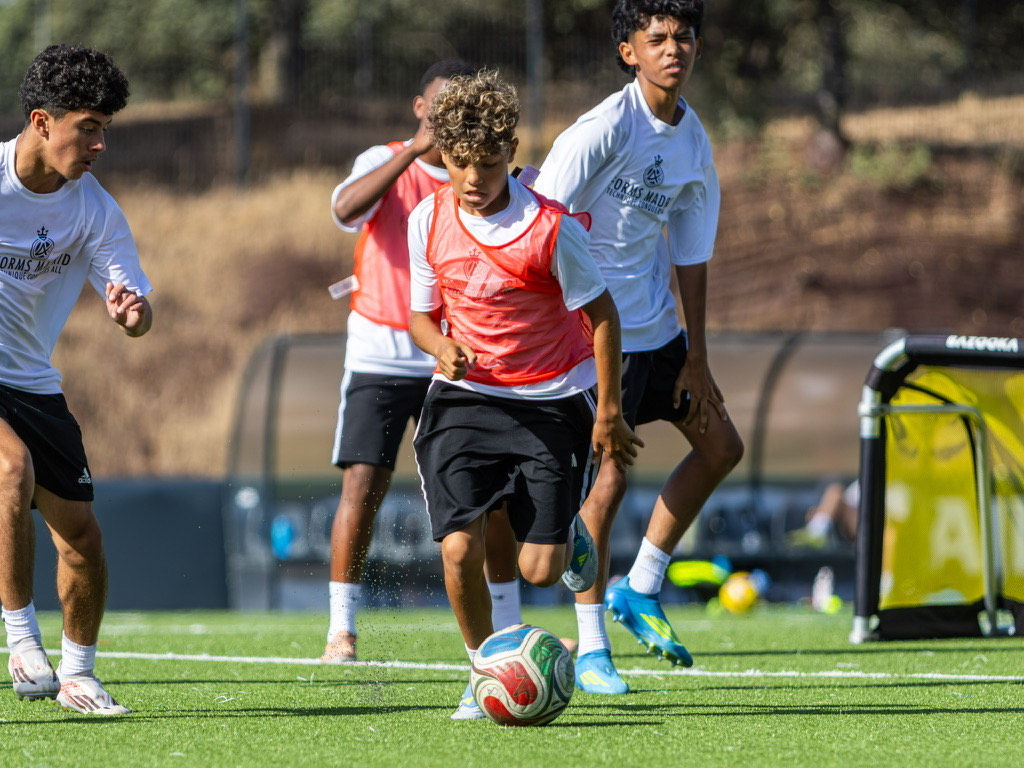
The environment does the teaching. The coach designs the environment.
The instruments
Every session, action and planning band has a named instrument, and they are never collapsed into each other. That separation is what stops a U10 session from becoming a career rank.
Names the kind of work an exercise is, from isolated repetition through to autonomous work in chaos. It answers: what job is this exercise doing?
Names the layer an action is on, from L1 Foundational Precision to L5 Expressive Synthesis. It answers: how automatic does this action stay as difficulty rises?
Planning bands written with age ranges so a club can staff a field. Never an age gate: readiness, not age, decides when a player moves on.
Illustrative profile, scored 1 to 10 by domain. The read is the contrast between domains, not the average: this profile says technical range is the bottleneck in an otherwise well-built player, so expanding it becomes the next block of work.
FORMAX scores five domains independently on a 1 to 10 scale: coordination and body control, kinesthetic feeling for the ball, accuracy and speed of execution, range of mastered technical elements, and functional application, the game-intelligence domain. Each evaluation also records the technical layer it was conducted at and how the technique holds under fatigue. Nothing is averaged into a single number, so a strong engine cannot hide a missing repertoire.
Do not average the domains. Read the contrast between them: the weakest domain is the training prescription.
In practice
In the foundational stages, training is individual ball mastery and small games: 1v1, 1v2, 1v3. Tactical lecturing is virtually non-existent. The coach manipulates space, time and rules so players are forced to discover technical solutions, and the chaos and errors are treated as the data of learning.
Numerical superiority is not taught with a whiteboard triangle. A transition game is designed so the 2v1 emerges naturally, and players discover, through their own automated technique, when to commit the defender and when to release. The concept is learned fused to the execution required to exploit it.
Young players are asked to dribble and try the skills they have, with zero option to pass, including in the box. The worst that happens is dispossession, and dispossession gets a thumbs up. Threat occupies working memory, so threat is removed from the session on purpose.
A team encouraged to dribble out of pressure will concede to organized, technically deficient teams in the early years. Forms accepts that trade knowingly: a player is evaluated on tolerance for pressure before release, never on early match results, because early results reward maturity, not development.
What is not published
The Manual's rulesets, named drill libraries, call lexicons, evaluation weights and week-by-week tables live inside the Forms curriculum and are taught in the program, not posted on a website. What is public is the reasoning. What is coached, daily and in person, is the system.
Admissions
Every Forms Madrid place begins with a conversation and an evaluation: academic placement in the Forms Academy curriculum, and a football assessment where needed. Applying costs nothing and commits you to nothing.